Gilded Age Shoes with Stories to Tell
I happen to like shoes—a lot. Many men seem to take less delight in them than do the ladies, but not me! For a lot of my male friends, anyway, footwear is viewed either as an afterthought or as a downright nuisance.
In the Gilded Age, shoes refused to be an afterthought—though they could be a darned nuisance. Read on!
Women’s shoes tended toward slim, high-buttoned boots or neat lace-ups, often closely fitted through the ankle. Kid leather was popular, as were fabric uppers that could be matched to a dress. For evening, things softened a bit with lighter, more delicate shoes, though still refined rather than showy. (Shoes weren’t as visible under long dresses or gowns as they are under today’s styles.) Men’s were sturdier and sometimes quite blocky (the ‘bulldog’ shoe comes to mind), were usually in dark leather, and were well-polished and well-kept. There was style in them, certainly, but it was a quieter sort. Clean lines, good materials and a proper fit were considered to be more important than ornamentation.
It’s fairly little known that winter shoes for men and women often had felt, not leather, soles. Snow was tough on leather, and leather and ice don’t mix well, so dense felt soles, often with hobnails for traction, made for good walking-to-work-or errands shoes or sometimes overshoes. Rubber soles weren’t nearly so common in those days—rubber was expensive and tended to wear more quickly than our modern equivalents.
Working folk, though, often could not afford specialty shoes or overshoes. They either purchased shoes with double-thickness leather soles, wore heavy woollen socks, or more commonly simply put up with wet feet. The only inexpensive alternative in such cases was to line their shoes with dry newspaper that could be discarded and replaced several times during a cold, wet day. And, sadly, many of them did ‘catch their death of cold’ from their lack of appropriate footwear.
For people of any social stratum, though shoes were not so much ‘fast fashion’ as an investment, and they were expected to last. A man or middle-class woman might have a dependable pair or two for daily wear, something finer for visits or evenings out, and perhaps a heavier or older pair for poor weather or travel. Each had its purpose and place, and each demanded its own measure of care. Shoes were cleaned, repaired, and kept in use as long as possible.
Even putting on one’s shoes was a kind of investment—in time and trouble. There were no zippers, no Velcro, and the only ‘slip-ons’ were house slippers. Thus one did not simply step into a shoe and quickly be finished and ready to go. Instead, the wearer sat, settled their foot properly into the shoe or boot (remember that the shoes were quite fitted), and then . . . reached for the button hook.
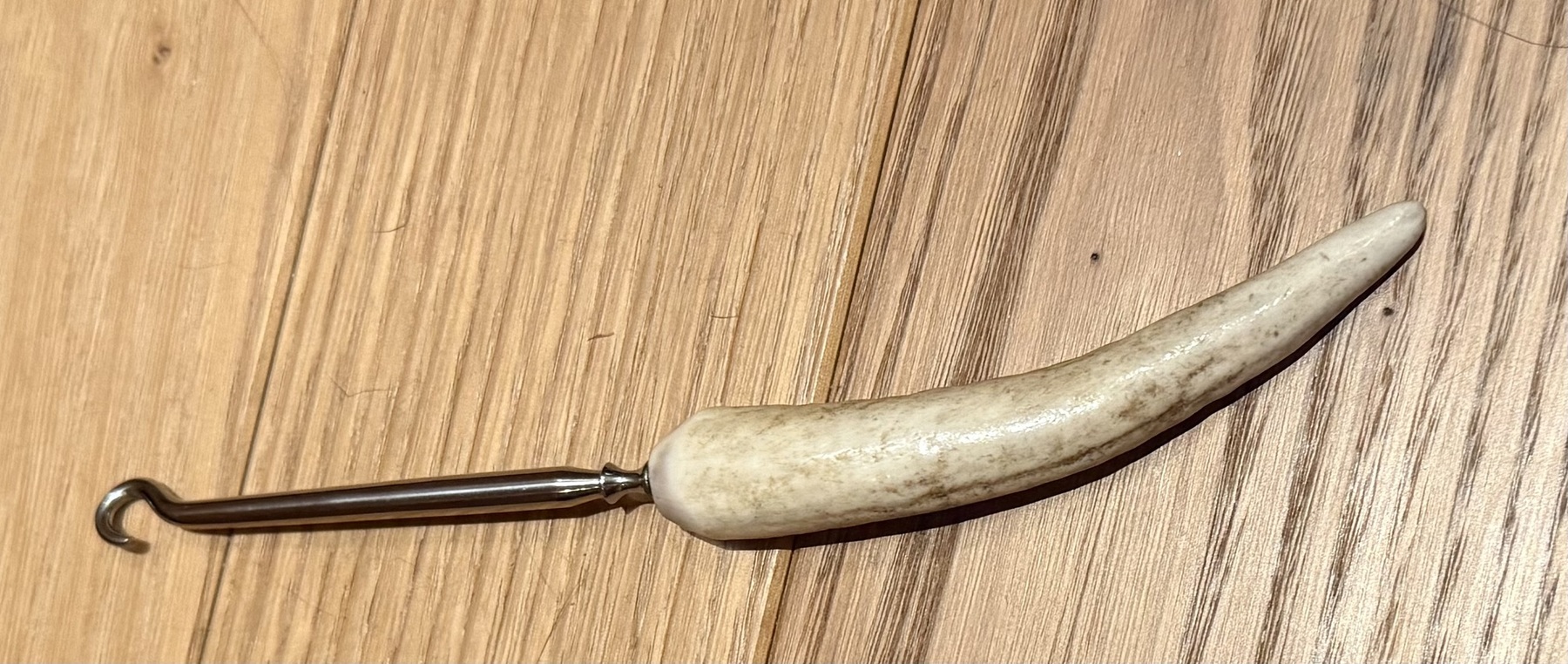
What is a button hook, you might rightly ask? It’s a small thing, easily overlooked, with a narrow handle and a curved metal hook. This small tool made the whole process of buttoning one’s shoes possible, if not sometimes frustrating and time consuming.
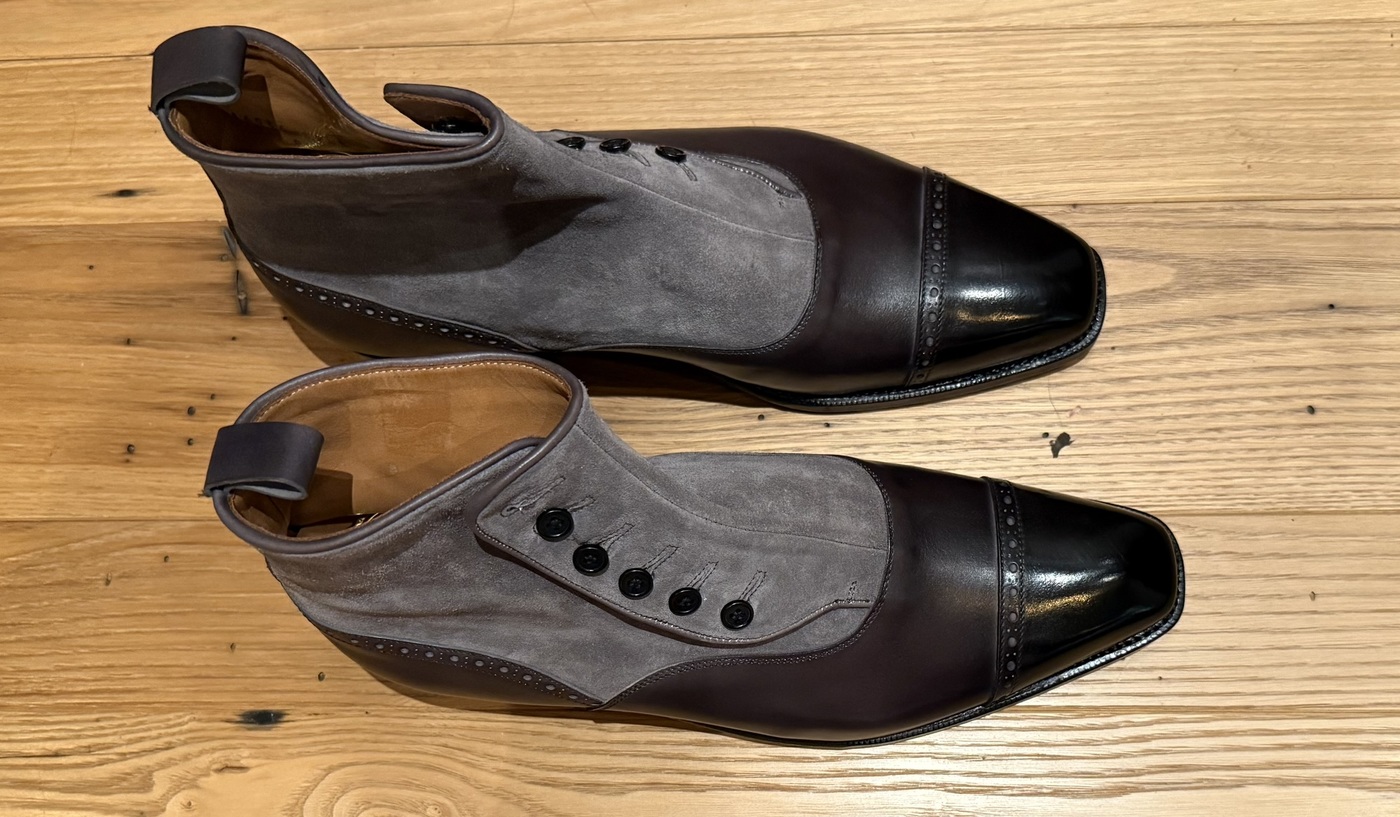
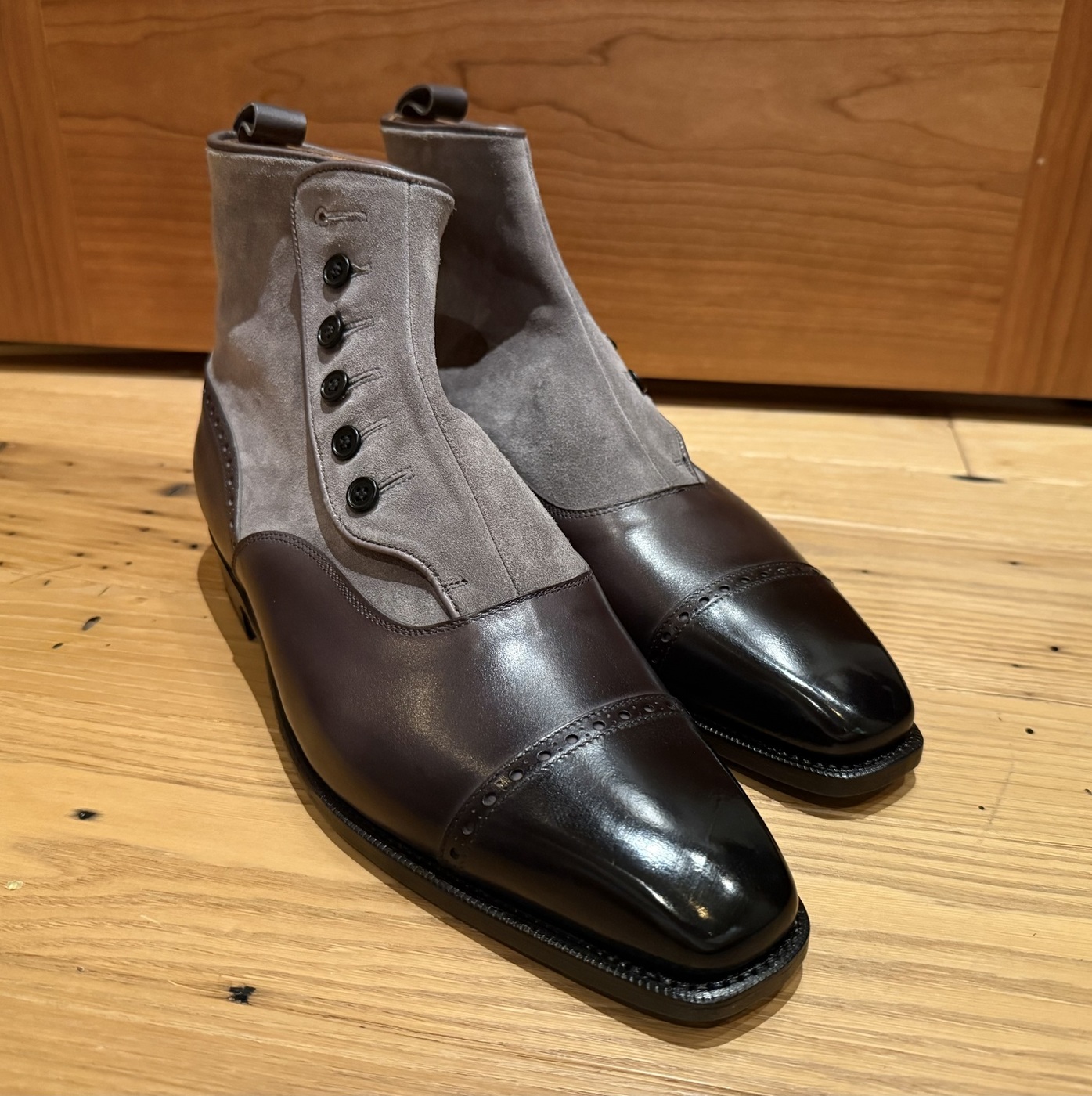
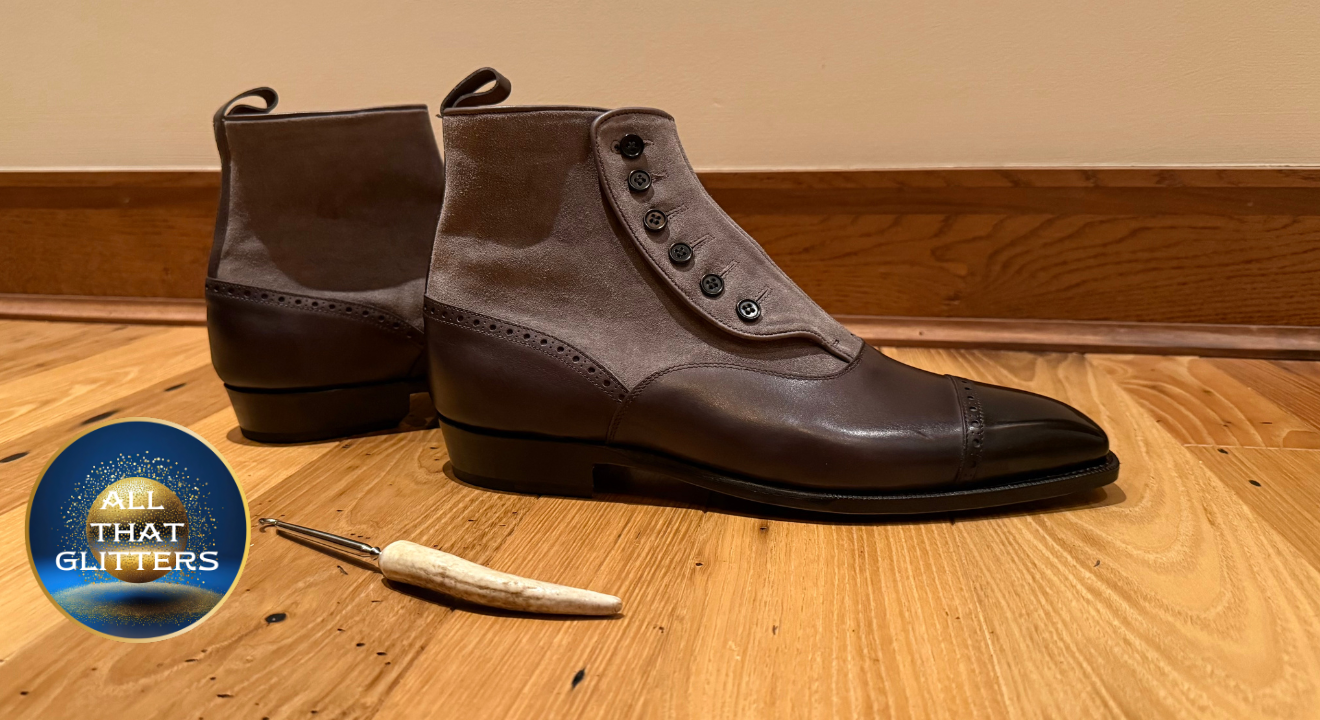
In fact, not long ago I purchased a pair of button-up men’s shoes from J. FitzPatrick (my pair is shown here, with my buttonhook), who still makes authentic Gilded Age shoes, just so I could get a sense of what it might be like to button on shoes insead of slipping or tying them on. Let me tell you, it takes a bit of patience!
First of all, using a button hook is less intuitive than it appears. One does not simply “grab and pull.” Instead, the hook is slipped carefully through the buttonhole from the outside, angled just so until it catches the shank of the button hidden beneath the leather edge. There is a moment—brief, but distinct—where one can feel it take hold. Then comes the draw: a controlled pull back through the hole, firm enough to guide the button, but measured enough to avoid slipping free at the last instant. And not so sharp or abrupt that you rip the button off!
Now you repeat that process with as many as a dozen buttons on each foot. In time, the wrist learns the correct turn; the fingers adjust their pressure; the eye grows accustomed to judging distance by instinct rather than sight. Still, at least for the button-shoe novice, it is not unusual to miss the catch entirely, or to pull too soon and lose the button halfway through. Multiply that when the leather is stiff or you’re in a hurry.
And yet, there is a peculiar satisfaction in mastering it. The hook transforms the mindless tying of shoelaces into a deliberate, almost meditatively process—one that promotes and rewards patience and care. And with each successful pull, the shoe draws closer around the foot—a peculiarly satisfying feeling. When finished, I at least feel a distinct sense of accomplishment!
While wearable ‘true vintage’ Gilded Age shoes are hard to find after more than a century, if you want to connect with old-school shoe technology, vintage buttonhooks (sold by the million back in the day) are plentiful on auction sites and generally inexpensive. Some are quite worn, too, which tells you that they were used daily by one of our forebears in a former age. I find just holding one to be vey conducive to imagination!